
Have you ever felt overwhelmed trying to manage medical images effectively across various imaging systems, only to realize that your workflow is slowed by technical limitations? You’re not alone. Many healthcare providers struggle with the complexity of storing, accessing, and interpreting medical image files generated by different PACS systems and multiple imaging modalities. The problem often lies in not knowing whether to continue with a traditional PACS (Picture Archiving and Communication System) or upgrade to a vendor-neutral archive. This uncertainty can lead to high costs, inefficiencies, and even the risk of vendor lock-in.
Fortunately, solutions like a vendor-neutral archive (VNA) and cloud-based PACS are evolving rapidly to address these pain points. By exploring the differences between VNAs and PACS, including how each handles imaging data from various departments and integrates with electronic medical records, you can make a confident, informed decision. In this blog post, we’ll walk you through everything you need to know—so you can take back control over medical data, streamline diagnostic imaging processes, and ultimately deliver better patient care.
Let’s dive in!
Key Takeaways
- Key Takeaway #1 – A picture archiving solution (PACS) focuses on fast retrieval of medical images and is ideal for single or smaller healthcare organizations. It’s cost-effective, easy to implement, and tightly aligned with radiology-specific workflows.
- Key Takeaway #2 – A vendor-neutral archive (VNA) stores medical images and related data from multiple PACS, allowing you to migrate from one vendor to another without losing essential imaging information. This vna solution supports both DICOM (Digital Imaging and Communication) and non-DICOM files, ensuring vendor neutrality and enterprise-wide interoperability.
- Key Takeaway #3 – The choice between PACS and VNA depends on your facility’s size, budget, and long-term goals. Large healthcare enterprises often benefit from deploying a VNA for enterprise image consolidation, while smaller facilities may find a traditional PACS sufficient. Cloud PACS options—like ProtonPACS by Radsource—offer the best of both worlds by combining advanced PACS functionality with scalable cloud benefits.
What is PACS?
Definition and Functionality
PACS, or picture archiving and communication system, is a specialized information system designed to store, retrieve, and manage medical images and reports digitally. At its core, a PACS server forms the backbone of image storage, efficiently handling imaging data from different sources—like MRI, CT, and ultrasound. These files typically adhere to DICOM standards (short for imaging and communication in medicine), which ensures that all medical images and associated data remain consistent and shareable across compatible systems.
In a typical setup, a PACS vendor integrates these crucial components:
- PACS server: The point of integration for storing and retrieving medical images
- DICOM viewer: Allows healthcare providers to interpret medical images with clarity and precision
- Integration with imaging modalities: Seamless connectivity to diagnostic imaging tools such as X-ray, CT, and MRI
When a healthcare organization uses a PACS, they gain rapid access to medical images, reducing the time spent waiting for film-based studies and enabling more efficient collaboration among radiologists, technologists, and referring physicians.
Why PACS is Still a Vital Tool
Despite the growing popularity of VNAs, PACS remains indispensable for many healthcare providers. Traditional PACS solutions are optimized for fast imaging retrieval and day-to-day workflow efficiency—particularly in radiology departments. For smaller facilities or single-department clinics, a PACS can be more cost-effective and simpler to set up compared to a broader enterprise archive like a VNA system. Additionally, a PACS storage environment is often tightly integrated with radiology-specific tools, ensuring that radiologists have everything they need to quickly interpret medical images.
Cost is another major factor. Since PACS focuses on one specialty—radiology—rather than the entire enterprise, hardware and licensing fees remain manageable. Moreover, a well-chosen PACS vendor will align the system’s functionalities with the existing workflows, thus minimizing downtime and training needs.
What is a Vendor Neutral Archive (VNA)?
Definition and Purpose
A vendor neutral archive—sometimes referred to as a vendor-neutral archive—is an information system designed for the storage of medical images and other content that often goes beyond DICOM, such as photos, videos, and even documents. Its primary strength lies in providing vendor neutrality, meaning it can seamlessly store medical images and data from multiple PACS, regardless of vendor. This eliminates the risk of tying your data to a single vendor and paves the way for easier future migrations or expansions.
A VNA is also capable of managing imaging data from different departments, allowing a healthcare organization to consolidate imaging resources under one umbrella. This approach provides a single source of truth for medical image management, making it easier to share and access data across the enterprise. By supporting both DICOM and non-DICOM content, a VNA allows for more robust interoperability—key to avoiding long-term vendor lock-in and ensuring that your data remains accessible if you move to another vendor or decide to implement new technologies.
Benefits of VNAs
VNAs offer a multitude of advantages, particularly for larger healthcare enterprises or networks where multiple PACS solutions are in use. By deploying a VNA, your organization can consolidate imaging data from various departments—radiology, cardiology, pathology, and more—into a single repository. This centralized structure greatly simplifies data sharing across the enterprise, ensuring that clinicians have timely access to medical images needed for diagnoses or treatment planning.
Moreover, a VNA provides enhanced lifecycle management of medical images and related data, so facilities can more efficiently comply with regulations for retention and archiving. Because it’s not tied to a single vendor, a VNA allows you to adopt new imaging technologies or even switch from one vendor to another without the headache of incompatible formats. Essentially, the VNA stores all imaging information in a standardized format, serving as the point of integration that extends beyond departmental boundaries.
Vendor Neutral Archive (VNA) vs PACS: A Comparison
Key Differences
When weighing vna vs pacs, it’s important to note that PACS is typically purpose-built for radiology workflows and day-to-day imaging needs, while a VNA is designed for long-term storage and broader enterprise-level interoperability. If you’re dealing with multiple PACS or data from different PACS systems, a VNA can serve as a unifying layer that ensures all imaging data remains consistent and easily accessible.
If we look at the features:
- Storage Focus: Traditional PACS primarily focuses on radiology, whereas a vendor neutral archive vs pacs perspective highlights that a VNA is more about enterprise-scale consolidation.
- Interoperability: A vna stands out for its vendor neutrality, offering the freedom to integrate new imaging systems regardless of vendor.
- Integration and Costs: While installing a new VNA system can be more complex and carry higher upfront costs, it potentially reduces the financial burden associated with managing imaging data from different departmental solutions in the long run.
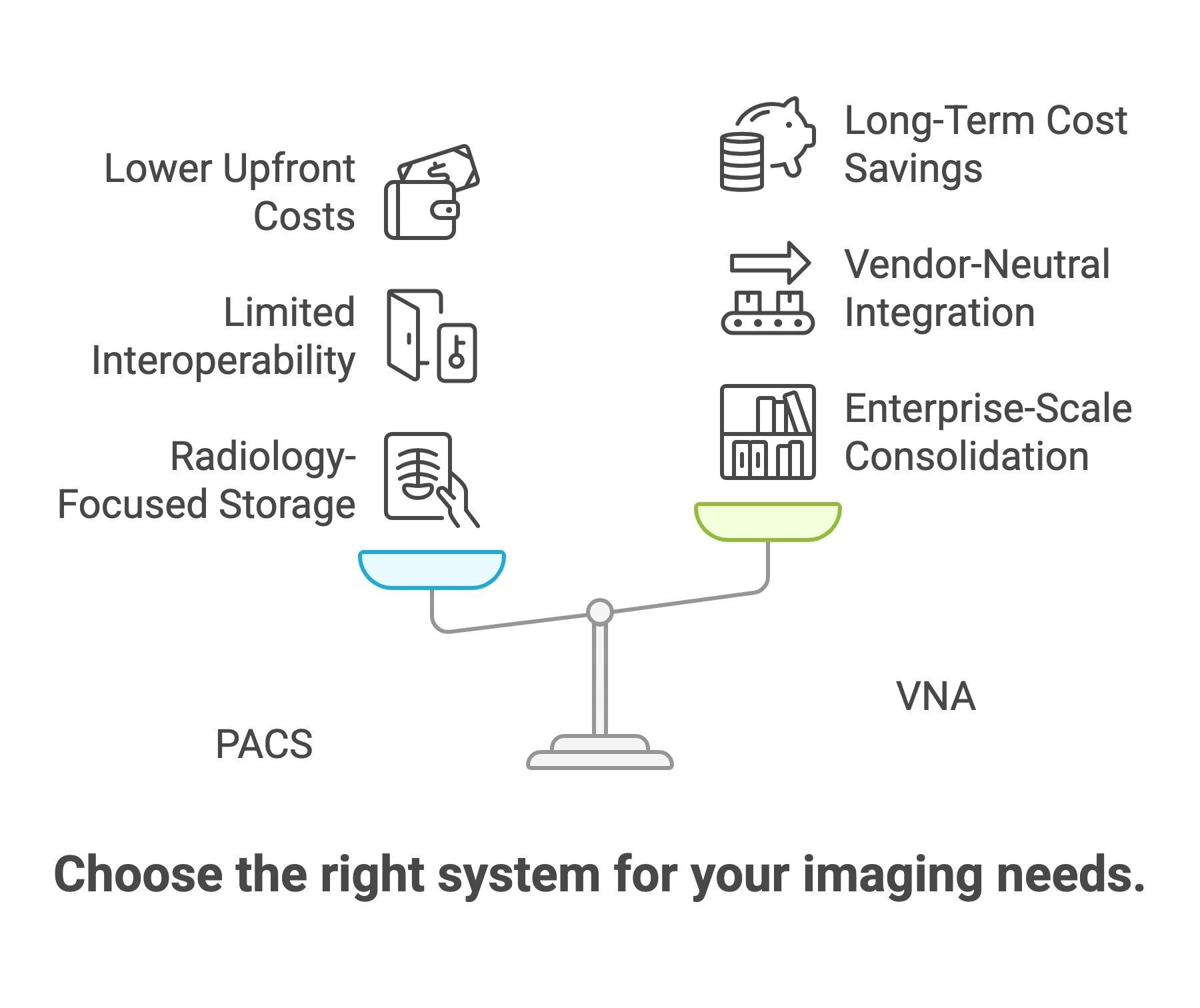
Vendor-Neutral-Archive-VNA-vs-PACS_-A-Comparison
Advantages of PACS
PACS continues to be the gold standard in many radiology departments, largely due to its speed and optimized workflow. For day-to-day operations, a traditional pacs environment excels in rapid retrieval of imaging data, ensuring that radiologists can quickly manage medical images for diagnosis. PACS is simpler to implement and maintain than a full-blown vna solution, especially in smaller facilities or clinics with limited IT resources.
Other benefits include direct integration with departmental systems, enabling specialized tools for reading and reporting. When you choose the right VNA or the right PACS, you can maintain staff productivity with minimal adjustments to their usual workflow. For this reason, PACS and VNA solutions can coexist in large facilities, but for many smaller organizations, a PACS alone can be enough.
Limitations of VNAs
While a vna offers significant benefits, it’s not always the perfect fit for every scenario. For example, vna implementation can come with higher capital expenses related to hardware, software, and migration. You may also need to factor in the complexity of consolidating data from different PACS systems, training staff, and ensuring minimal downtime during transition. If your facility operates a single, old pacs that’s already meeting all your radiology needs, a VNA might be considered redundant.
Additionally, in some smaller settings, the broad capabilities of a VNA might go underutilized. If you don’t need to integrate with multiple PACS or manage medical images enterprise-wide, the return on investment for a VNA can be less compelling.
Why PACS is Evolving: The Role of Cloud-Based PACS
Introduction to Cloud PACS
The healthcare sector has seen rapid digital transformation, and medical imaging technology is no exception. Cloud-based PACS represents the next step in the evolution of imaging. Instead of relying on on-premises hardware that needs regular updates, a cloud PACS operates on remote servers, thereby offering scalability and significant cost savings. This modern approach also allows more flexibility in how you store medical images, as you can scale your storage capacity based on actual demand rather than guessing future needs.
Additionally, cloud-based pacs solutions provide remote accessibility, letting authorized users securely view and analyze medical images and data from any location. This can expedite collaboration among specialists across disparate locations, leading to faster diagnoses and more efficient care.
ProtonPACS by Radsource
One leading option in pacs solutions is ProtonPACS by Radsource. Built to meet the demands of modern healthcare organizations, ProtonPACS delivers the key features radiologists need: a user-friendly interface, high-speed imaging storage and retrieval, and robust security measures to protect patient data.
Moreover, ProtonPACS goes beyond a new PACS installation by harnessing the benefits of the cloud. In addition to offering VNA solutions for those who need them, Radsource’s team understands the complexities of medical image management and stands ready to assist with seamless integration. Healthcare providers seeking a cutting-edge pacs vendor that can adapt to future technological shifts can benefit from exploring what ProtonPACS has to offer.
When to Consider a VNA: Practical Scenarios
Scenarios Where VNAs Shine
A vna truly excels in healthcare enterprises that have multiple departments—radiology, cardiology, pathology—and need a single, enterprise image repository. For instance, if your facility maintains data from different pacs or anticipates growth into new specialties, a VNA’s interoperability ensures you won’t have to juggle multiple siloed systems. Additionally, for organizations looking to keep data accessible for research or educational purposes long after it’s archived, the vna structure simplifies retrieval and ensures vendor neutrality.
Another scenario involves large networks that must share imaging data across various imaging modalities or even across separate campuses. Using a vna helps maintain consistency in formats, so medical images and reports remain easily transferable between departments. Deploying a VNA can also simplify system upgrades because the data layer remains stable even if you replace or update the front-end systems.
When PACS is Enough
On the other hand, if you run a small or specialized clinic where managing imaging data from different specialties isn’t a concern, sticking with a pacs system may suffice. The simpler workflows, lower upfront cost, and ease of maintenance often make a PACS more attractive for smaller facilities. If your existing PACs is meeting all your radiology needs and your budget is tight, making the leap to a large-scale VNA might not be cost-effective.
For these reasons, it’s crucial to weigh the differences between vnas and pacs against your unique clinical requirements, staff capacity, and financial constraints. Sometimes, the best solution may be to upgrade to a new pacs with enhanced features rather than invest in a vna that extends well beyond your current needs.
Deployment Strategies: PACS to VNA or VNA to PACS?
Migrating from Existing PACS to VNA
For large facilities seeking to expand or unify their imaging ecosystems, the transition from pacs to vna is a strategic move. This process typically involves an installation of a new vna, data migration, system integration, and comprehensive staff training. You’ll need to ensure capabilities of your existing pacs align with the vna so that your staff can continue their usual workflows with minimal interruptions. Migrating large volumes of imaging data can be challenging; planning for downtime, ensuring data compatibility, and selecting a reliable vna vendor are critical to success.
While initial costs and technical complexity can be high, the long-term payoff is substantial. A robust vna environment allows your organization to leverage medical imaging technology that provides consistent data archiving, advanced search capabilities, and the flexibility to migrate from one vendor solution to another vendor without losing historical records.
VNA to PACS: A Rare Scenario
In some unusual circumstances, an organization might choose to revert from a vna to pacs. This generally occurs if leadership decides that the broad, enterprise-scale approach of a vna is too extensive for their current needs or budget. VNA to PACS can mean implementing a simpler departmental workflow, reducing the overhead of maintaining a large-scale VNA. Some smaller facilities or specialized clinics might find that a pacs vendor offering specialized features can better support their niche imaging requirements.
However, this scenario is quite rare. Once a healthcare organization invests in a vendor-neutral archive, the typical path is to maintain that environment and possibly expand it over time. Still, the option remains open—healthcare technology is never one-size-fits-all, and each facility has unique constraints and goals.
Choosing the Right System for Your Facility
Factors to Consider
When deciding whether to invest in a vna or stick with a pacs, consider several factors:
- Facility size and imaging needs: Large, multi-department systems often benefit from a vna. Smaller facilities may prefer a PACS.
- Budget constraints and long-term goals: While vna implementation can require higher upfront spending, it can pay off with better integration, simpler migrations, and the ability to handle medical images and data from various specialties.
- Vendor reliability and support: Whether you’re choosing a vna or a traditional pacs, ensure your vendor providing the solution has an excellent track record and offers support throughout the system’s lifecycle.
Evaluating these aspects helps you determine if you should continue with a vendor-specific PACS or invest in a vna system that supports broad interoperability and long-term data retention. Remember, the control over medical data is paramount—selecting a tool that allows you to adapt as medical imaging software evolves is crucial for maintaining a cutting-edge practice.
The Role of Radsource in Your Decision
Radsource stands out for offering vna solutions as well as advanced pacs solutions like ProtonPACS. The company’s expertise goes beyond just image storage; it focuses on helping institutions streamline workflows, manage imaging data, and make data-driven decisions with confidence. Radsource’s true vendor-neutral approach ensures that you retain flexibility as your facility grows or your needs change.
Choosing Radsource means you have a partner capable of managing imaging data from different departments in a unified, streamlined manner. By collaborating with Radsource, you can either maintain or enhance the capabilities of your existing pacs or opt for the installation of a new vna—whichever aligns best with your organizational strategy. They understand that every practice is unique and are committed to helping you find the right solution, whether that’s pacs and vna working hand in hand or a stand-alone approach.
Conclusion: The Future of Imaging Data Management
In the ever-evolving world of medical imaging technology, both vna and pacs play crucial roles. The best choice depends on factors like your facility’s size, resources, and growth trajectory. A vendor-neutral archive offers the benefit of vendor neutrality, advanced data consolidation, and simpler expansions in the future, particularly for larger institutions. Meanwhile, many facilities continue to trust a traditional PACS as the backbone of their imaging workflow, especially if they specialize in radiology or have limited budgets.
The key is recognizing that these two solutions don’t always compete. They can complement each other, or you can choose a single solution based on your clinical scope. Looking ahead, cloud-based solutions such as ProtonPACS by Radsource are paving the way for more scalable, reliable, and cost-efficient imaging management. If you’re ready to explore a system that can grow with you and adapt to the changing demands of the industry, check out ProtonPACS and discover how it can help you provide top-notch patient care.
FAQs on PACS vs Vendor Neutral Archive
- What is the difference between Vendor Neutral Archive vs PACS?
VNA and PACS serve different but complementary purposes. A PACS focuses primarily on radiology workflows and quick access to medical images, whereas a VNA is designed for enterprise-wide data consolidation and long-term archiving. The vna stores data in a format that allows interoperability and prevents single vendor lock-in, while a PACS typically manages images for one specialty. - Can VNAs replace PACS entirely?
While a VNA is approved for storing and managing large volumes of imaging data, it often doesn’t completely replace the specialized workflows, tools, and speed that a PACS offers—especially in radiology. Many facilities opt to use both, with the VNA serving as an enterprise archive and the PACS as the day-to-day operational system. - How does a cloud-based PACS improve imaging workflows?
A cloud-based PACS such as ProtonPACS leverages remote servers for data processing and storage, reducing the burden on onsite infrastructure. This model offers capable of managing imaging data more flexibly, letting you scale storage capacity, reduce hardware costs, and enable remote access. For instance, a radiologist can quickly retrieve medical images and reports from any location, speeding up diagnoses and enhancing collaboration.
