
PACS System Key Components
Introduction
In today’s rapidly evolving healthcare system, managing large volumes of medical image data is essential for timely diagnoses and efficient patient care. One of the most transformative solutions in this space is the picture archiving and communication system (PACS), which streamlines the way healthcare professionals handle imaging studies. By replacing film-based processes and conventional systems, PACS facilitates faster retrieval of medical images and ensures a more seamless workflow for radiologists, technologists, and other stakeholders.
Using PACS allows healthcare providers to access, store, and interpret medical images in digital form—vastly improving data management and communication between different departments. Whether you’re dealing with X-rays, computed tomography scans, or other different imaging modalities, a robust PACS environment makes it possible to retrieve and share images securely, all while maintaining compliance with healthcare standards.
In this article, we’ll explore the key components of a PACS system and highlight how Radsource’s ProtonPACS can help you optimize your radiology process.
Understanding Picture Archiving and Communication System (PACS)
What is PACS?
A PACS, or picture archiving and communications technology, is an important component of the PACS network that revolutionized how we handle medical image data. Instead of relying on film-based systems, PACS can handle digital files to reduce costs, improve efficiency, and boost collaboration among healthcare professionals.
The Four Main Components of PACS
The four main components of PACS reflect how pacs includes the essential technologies to capture, store, and view diagnostic images across the entire health care system. From image acquisition devices to robust archiving, these main components pave the way for accessible and highly efficient medical system operations. Below, we’ll break down each component of the PACS network.
1. Image Acquisition Devices
PACS begins with image acquisition from various imaging modalities.
Modalities include:
- X-ray machines
- MRI and CT scanners
- Ultrasound devices
- PET and nuclear imaging systems
- Role of DICOM (Digital Imaging and Communications in Medicine) standards in ensuring interoperability
PACS begins with image acquisition from an array of image modalities, such as X-ray, computed tomography, and ultrasound. This stage also includes specialized scans like nuclear medicine—each modality generating critical medical image files. One of the major roles of using acquisition devices is to produce high-quality images that can be sent to the pacs server for secure storage media and archive system processes.
The national electrical manufacturers association developed DICOM (Digital Imaging and Communications and imaging and communications in medicine) as a specification to the pacs standard format that unifies various imaging technologies. By following manufacturer’s specification to the pacs, these devices ensure compatibility across pacs vendors and hospital infrastructures. So, when images are captured from a radiology system or other clinical settings, they can seamlessly communicate with pacs software—making them ready for rapid retrieval and comprehensive analysis by the radiologist.
Viewing and Diagnostic Workstations
2. Data Transmission Networks
The backbone of PACS for secure and efficient transmission of medical data.
Components:
- High-speed LAN (Local Area Network) for intra-hospital image transfer
- WAN (Wide Area Network) for remote access and inter-hospital data sharing
Features:
- Secure protocols for data transmission
- Encryption to ensure compliance with healthcare standards
Networks form an important component of the PACS ecosystem. A pacs network typically uses a high-speed LAN for intra-hospital data flow and a WAN for connectivity to systems and to remote locations. This transmission of medical data between the components is crucial, as it allows real-time access to imaging studies by clinicians across multiple sites.
To comply with healthcare regulations and safeguard patient records, robust encryption and secure protocols are employed. Whether it’s retrieving a study from the cloud PACS or sending it to a server on-site, the system requires consistent security measures. In addition, pacs provides ways to monitor network performance to prevent system failure, ensuring that healthcare providers always have reliable access to images and related data.
3. Storage and Archiving Systems
Centralized repositories where medical images and related data are securely stored.
Types of Storage Solutions:
- Short-term storage for active cases
- Long-term archiving for regulatory and clinical needs
- Cloud-based storage for scalability and remote access
Role of redundancy and disaster recovery in ensuring data integrity.
Once acquired, images and related data must be properly archived for both short-term and long-term needs. Traditional PACS solutions store images on local servers, but modern systems often employ cloud-based PACS or cloud PACS approaches to bolster efficiency and reliability. These solutions offer advanced backup and data management features, including redundancy and disaster recovery, to shield against system failure.
Storage media—like hard drives and other digital repositories—form the backbone of an archive system that can be pacs server for archiving or an offsite location, depending on the pacs implementation strategy. By maintaining thorough redundancy, a facility can ensure that pacs can handle any unexpected outages or data corruption. Overall, pacs offers better accessibility than film-based solutions, enabling staff to retrieve or view records seamlessly, even in emergencies.
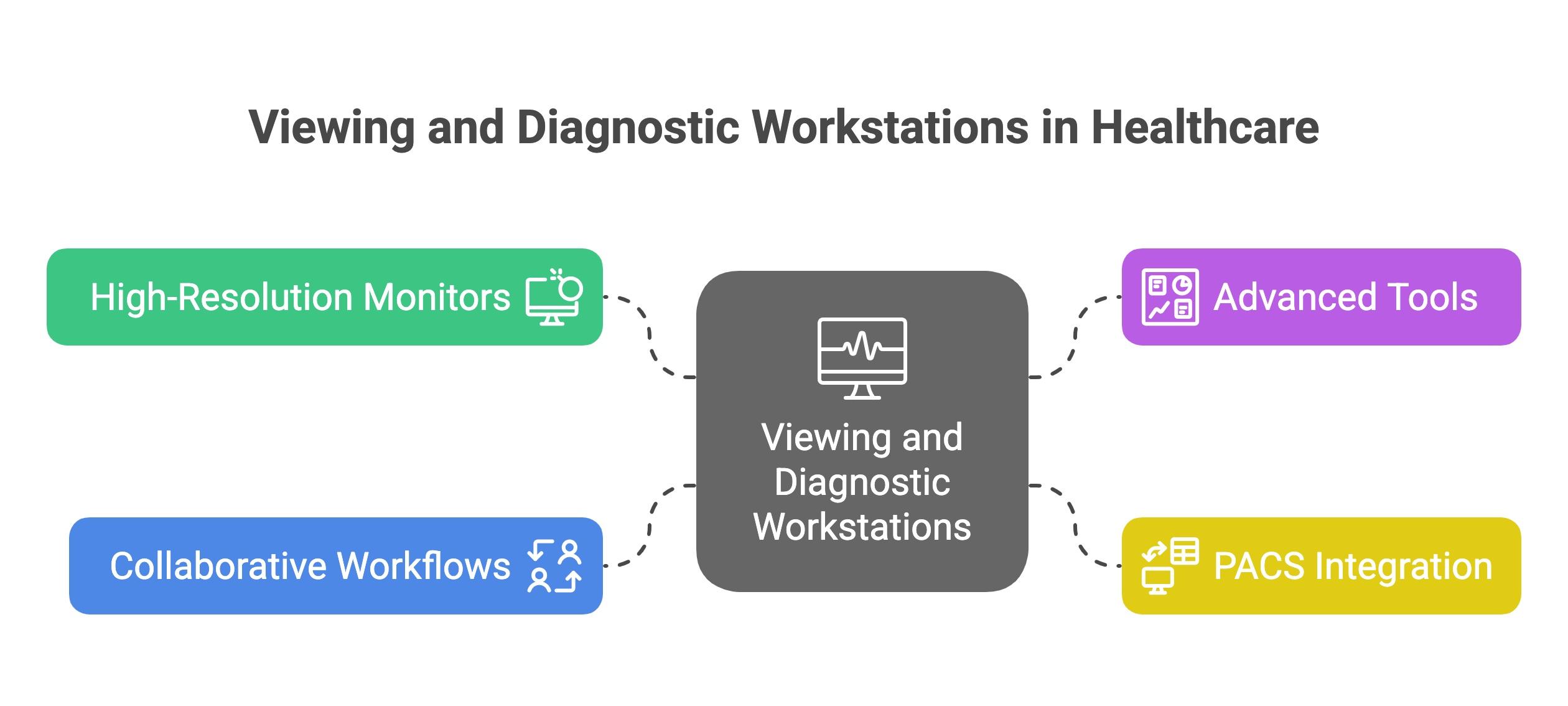
4. Viewing and Diagnostic Workstations
Workstations are the primary interfaces for radiologists and healthcare professionals.
Key Features:
- High-resolution monitors for detailed image analysis
- Advanced tools like 3D reconstructions, annotations, and multi-planar views
- Integration with PACS Software
- Seamless access to patient data alongside medical images
- Support for collaborative workflows across healthcare teams
- Integrating PACS with Healthcare Systems
Workstations are where the radiologist and other healthcare professionals interact with medical imaging software to interpret clinical findings. A workstation typically has advanced visualization tools—like 3D reconstructions and multi-planar views—that streamline the workflow. Because these stations are interfaced with the pacs server, users can retrieve any relevant image files, patient records, or radiology information swiftly.
Moreover, using PACS software at these stations bolsters collaboration. PACS should provide the ability to integrate with other clinical platforms, facilitating communication between teams. This synergy helps in diagnosing patients more quickly and accurately, showcasing the benefits of pacs in a modern healthcare system.
Viewing and Diagnostic Workstations
Radiology Information System (RIS)
A radiology information system (RIS) is another information system integral to robust patient care. When it is interfaced with the pacs server, it allows for automatic syncing of patient demographics and scheduling data with newly generated imaging studies. This synergy ensures that the radiologist can see the most accurate and up-to-date information.
Hospital Information System (HIS) and Electronic Health Records (EHR)
PACS integration with a hospital information system and electronic health records is fundamental to delivering holistic patient care. These platforms house everything from laboratory results to clinical notes, enabling providers to view relevant data in one place.
By bridging the gap between imaging studies and EHR data, pacs allows clinicians to cross-reference images with vital patient metrics quickly.
What Makes ProtonPACS Stand Out?
Key features include:
- Seamless integration with RIS and EHR systems
- Scalable cloud-based storage
- User-friendly diagnostic tools for radiologists
Radsource’s ProtonPACS is a next-generation pacs solution designed to address the complexities of modern radiology. By offering cloud-based PACS architecture and advanced customization options, ProtonPACS aligns with the manufacturer’s specification to the pacs standard. The system is built to grow alongside a facility—whether it’s a small clinic or a large hospital network—ensuring the same high-quality performance in pacs environment expansions.
Because it meets the pacs standard format, ProtonPACS is easy to integrate with ris systems and EHR platforms. This level of interoperability supports enhanced data management across diverse departments, from radiology to cardiology. By communication between different imaging tools and departmental software, ProtonPACS helps organizations optimize their major components of data flow.
Conclusion
The components of a pacs—spanning data transmission networks, storage media and archive system solutions, workstations, and pacs server integration—form the digital framework that modern imaging practices rely on. These components of PACS help reduce the burdens associated with film-based workflows and simplify daily operations in radiology departments. By implementing a PACS system that meets the specification of the pacs standard, healthcare facilities can stay ahead of the curve.
Thanks to pacs vendors like Radsource, pacs implementation is more accessible than ever. ProtonPACS exemplifies how a well-designed pacs solution can optimize every aspect of your imaging processes, from initial study capture to advanced post-processing. With the ability to be interfaced with the pacs server for archiving and integrated with hospital information system platforms, it stands out as a cutting-edge tool for modern care environments.
Ready to embrace the benefits of PACS and elevate your radiology pacs experience? Discover ProtonPACS and learn how its intuitive approach can revolutionize your clinical and administrative workflows. Don’t let outdated, conventional systems limit patient care—switch to a system that matches your facility’s ambitions. It’s time to harness the power of PACS and unlock better patient outcomes.
The components of PACS form the foundation of modern medical imaging, enabling seamless workflows and efficient image management. By understanding and leveraging these components, healthcare facilities can improve operational efficiency and patient care. Explore how Radsource’s ProtonPACS can elevate your radiology practice with cutting-edge solutions tailored to your needs.
Ready to transform your imaging workflow? Discover ProtonPACS.
