
Healthcare professionals often spend significant time dealing with fragmented tools, limited access to patient data, and outdated methods for managing medical images and related data.
Whether it’s a challenging diagnostic scan, a detailed X-ray, or an intricate MRI, clinicians and radiologists face hurdles when they need to install separate solutions for capturing, storing, and interpreting medical imaging data. This disjointed approach not only hinders workflows but also stalls efforts to improve patient experiences and patient outcomes.
When healthcare organizations and healthcare providers rely on multiple, different systems that don’t communicate seamlessly, valuable patient information is scattered or lost. Imagine attempting to retrieve a critical radiology report only to discover you need to manually pull up separate platforms, each with its own login and unique interface. This can slow diagnoses, lead to inefficiencies in radiology departments, and—most concerning—impact the quality of patient care.
Enter the picture archiving and communication system, or PACS—a software system built to revolutionize the way healthcare teams capture images and store sensitive medical information. In this blog post, we’ll explore PACS features, the key features that make these solutions invaluable, and how you can streamline your entire workflow by using PACS. From cloud-based storage and advanced analysis tools to strong data security measures, you’ll see how a modern PACS system can solve some of the biggest challenges in radiology and modern healthcare.
Key Takeaways
- Key takeaway #1: A PACS centralizes patient images, enabling healthcare professionals to access and view medical data quickly, eliminating the need for traditional film-based approaches.
- Key takeaway #2: Advanced workstation tools, AI enhancements, and enterprise imaging capabilities are key features of modern PACS solutions, helping clinicians achieve accurate diagnoses and enhance visualization.
- Key takeaway #3: Cloud-based pacs like ProtonPACS offer access from any device, robust data storage options, and compliance with regulations like HIPAA, making them a top choice for many healthcare providers.
What is PACS? A Quick Overview
An effective Picture Archiving and Communication System serves as a digital hub used to store and manage various medical images. Traditionally, medical image management was cumbersome due to physical films and the lack of seamless transmission of medical images.
Over the years, PACS has evolved in tandem with imaging technologies like MRI, x-ray, CT, and ultrasound, offering an interconnected platform that fosters collaboration between radiology teams, technologist staff, and other healthcare facilities.
Notably, PACS integrates easily with a radiology information system (RIS), electronic health records, and even teleradiology frameworks.
Core PACS Features Revolutionizing Medical Imaging
In this section, we’ll dive into the core PACS features that revolutionize diagnostic imaging and shape modern radiology.
Centralized Medical Image Storage and Management
At its core, a PACS provides a centralized repository for medical image files, ensuring images are stored securely for quick retrieval and review. This centralization gives radiologists and healthcare professionals immediate access to digital medical scans, including images from different imaging devices like MRI, CT, and ultrasound.
With PACS, there’s no need to install multiple siloed tools; all patient images can be handled in one place.
Multi-Modality Support
One of the key features of a robust PACS is its ability to handle diverse modality types, from x-rays to nuclear medicine. This is crucial for diagnostics in specialized fields like cardiology and mammography, where a single scan can provide a complete picture of patient anatomy.
Because PACS and RIS work harmoniously, healthcare teams can store, access, and interpret images from multiple sources with ease.
Advanced Workstations for Image Analysis
Modern PACS solutions often come with an advanced workstation environment that harnesses AI algorithms, 3D reconstructions, and automated measurements. These innovations help radiologists diagnose conditions more accurately, reducing the turnaround time for a radiology report.
Such advanced tools offer better visualization capabilities, facilitating accurate diagnoses and contributing to improved patient outcomes.
Worklist Automation and Real-Time Updates
A robust PACS solution eliminates the chaos of juggling multiple scheduling platforms by automatically updating and assigning tasks. This worklist automation means imaging orders from PACS and ris can sync seamlessly, enhancing staff efficiency and reducing errors. Healthcare data becomes more transparent and easier to handle, reducing administrative burdens and improving patient care quality.
Accessibility Across Devices
Today’s cloud-based PACS solutions offer cloud storage, enabling images and reports to be accessed from anywhere, anytime. This remote access and view approach is vital for healthcare teams spread across multiple departments or even different geographical locations. By embracing cloud PACS, healthcare organizations can streamline collaboration, facilitating more efficient consultations and faster decision-making.
Compliance and Security
Storing and transmitting sensitive medical information requires adherence to regulations like HIPAA. A secure PACS offers built-in encryption, data security protocols, and reliable backup systems to protect healthcare data. This ensures that patient information remains confidential, even as it travels between healthcare facilities or is stored in cloud-based servers.
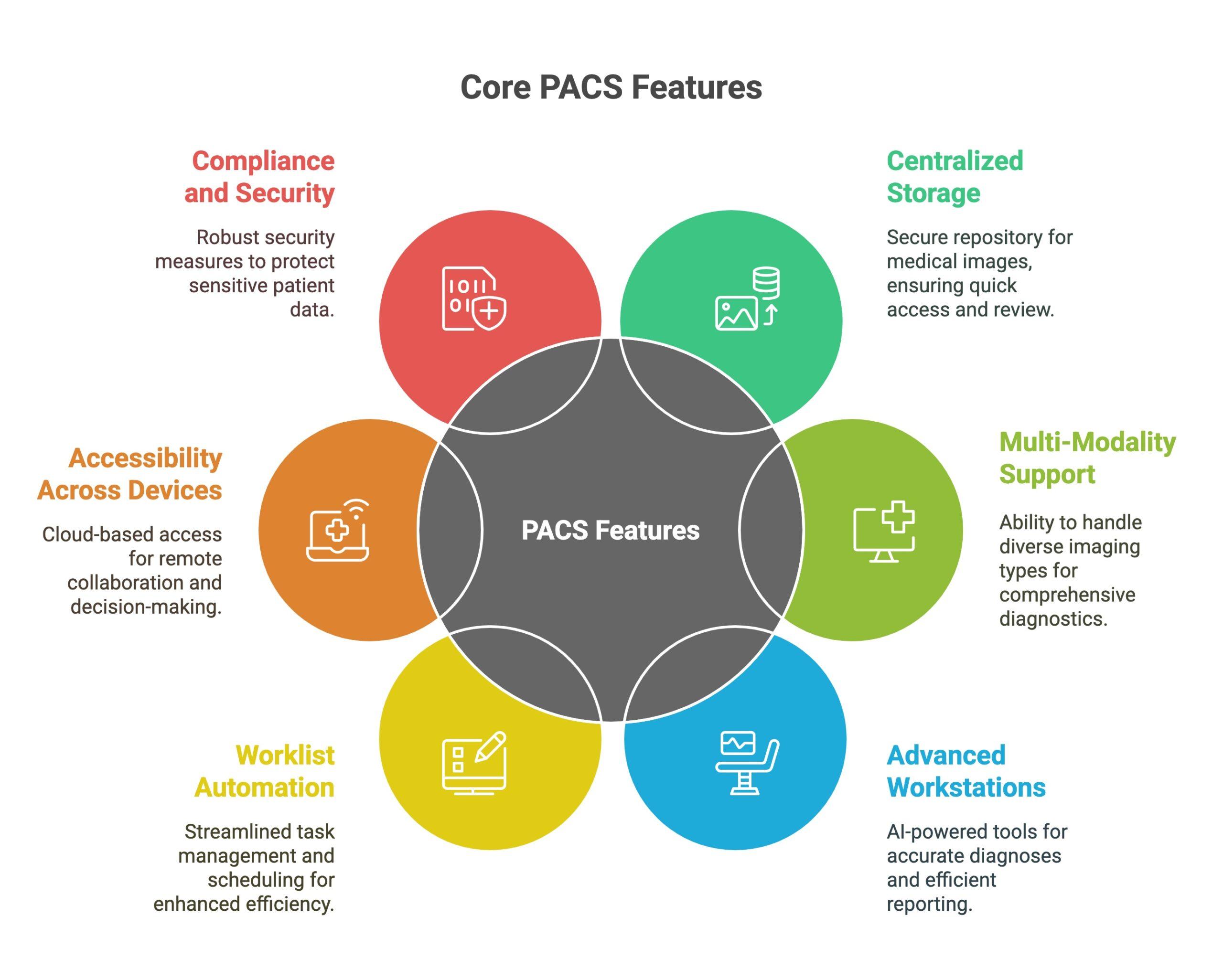
Core PACS Features
Why ProtonPACS by Radsource Stands Out
PACS allows healthcare teams to improve patient care dramatically, but not all PACS solutions are created equal. ProtonPACS by Radsource excels in offering specialized functionalities that take radiology and medical imaging to new heights.
Tailored Solutions for Radiology Professionals
ProtonPACS is designed with the radiology department in mind, offering functionalities that specifically cater to radiologists, imaging centers, and healthcare providers. By focusing on the unique challenges these groups face, ProtonPACS aligns perfectly with many healthcare workflows. Its enterprise imaging capabilities ensure that large and small healthcare facilities can scale as patient volumes grow, making it especially helpful for imaging centers that handle high throughput.
Features of ProtonPACS
Beyond its core design, ProtonPACS offers advanced worklist management, ai-enhanced tools, and robust integration with DICOM standards. It also supports quick-view medical capabilities via a cloud-based portal, so images and radiology reports can be shared for immediate consultation. This eliminates long wait times and fosters collaborative diagnostic processes that enhance patient care.
Unmatched Support and Reliability
One of the biggest advantages of ProtonPACS is its comprehensive support structure—ensuring seamless onboarding, integration, and maintenance. Because PACS solutions involve the transmission of medical images, any downtime can disrupt patient care and improve patient complexities. ProtonPACS mitigates this risk by providing expert guidance, reliable data storage, and proactive system monitoring. It’s trusted by healthcare America leaders, reflecting its strong performance record.
Conclusion: The Future of PACS Features in Healthcare
As modern radiology continues to evolve, PACS solutions remain at the forefront of revolutionizing efforts that shape patient care and patient outcomes. From centralized medical image repositories to advanced workstation tools with AI, a picture archiving and communication approach stands as the glue that holds next-generation imaging technologies together. By merging digital imaging standards with healthcare data best practices, PACS offers a complete picture of patient information to diagnose and treat effectively.
In particular, advanced PACS platforms like ProtonPACS illuminate the pathway for healthcare professionals seeking agile enterprise imaging and cloud-based strategies that are as scalable as they are secure. Such solutions are not just about convenience; they are about improving patient care, protecting sensitive medical information, and supporting the entire radiology department. By choosing the right PACS, healthcare Americans can unify digital imaging and communications protocols, capture images and store them seamlessly, and deliver faster, better outcomes for every diagnostic case.
Embracing future innovations in PACS means eliminating the need for scattered platforms and adopting a single, centralized environment for all images and reports—ensuring that radiology information is consistently accurate and easily accessible. In doing so, we not only improve patient outcomes but also drive efficiency and cost-effectiveness throughout the healthcare continuum.
Now is the time to explore modern PACS solutions. Whether you’re looking to integrate with a radiology information system, expand teleradiology services, or streamline existing workflows, consider a proven, future-focused solution like ProtonPACS by Radsource. It’s an investment that pays dividends in data security, swift diagnostic processes, and higher-quality patient care.
