
A Cloud PACS (Picture Archiving and Communication System) is a web-based platform that allows healthcare providers to store, access, and share medical images securely.
Over the past decade, the healthcare industry has embraced cloud PACS technology to improve operational efficiency and reduce costs. Also known as Hosted PACS, PACS Software as a Service (SaaS), Off-site PACS, and Web-based PACS, these systems must meet the criteria established by the National Institute of Standards and Technology (NIST) to qualify as cloud services.
The transition to cloud PACS is rapidly accelerating, with over 80% of healthcare IT executives already having made the switch to cloud services. Cloud PACS technology is a game changer, offering multiple benefits to healthcare organizations from small clinics to large hospitals.
Below are five key benefits of adopting a cloud PACS system.
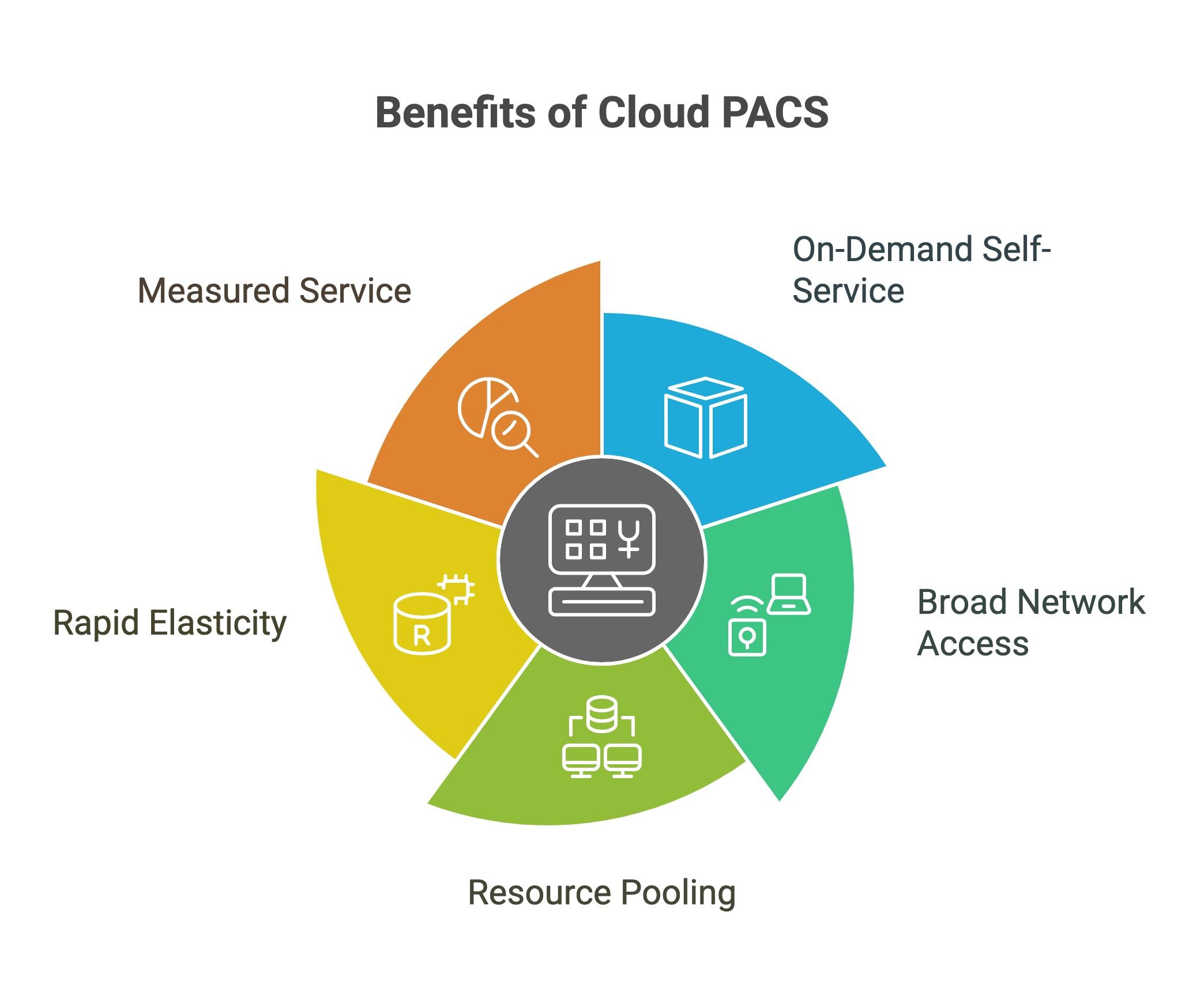
1. On-Demand Self-Service
Cloud PACS systems offer healthcare organizations the flexibility to manage resources and scale operations without interrupting workflow. With on-demand self-service, users can quickly access necessary resources such as storage, software features, and network capacity.
Traditionally, making changes to a PACS system—whether adding new users, expanding storage, or upgrading software—required vendor assistance. This often led to delays and extra costs. However, with cloud PACS technology, healthcare providers can make these changes internally, in real-time, without waiting for external help.
Additionally, remote updates ensure that the latest software versions and security patches are installed with minimal downtime. This autonomy allows organizations to stay operational and focus on patient care rather than technical troubleshooting.
Key Benefit: Healthcare providers gain greater control over their PACS system, reducing the need for outside support and minimizing disruptions to patient services.
2. Broad Network Access
Cloud PACS technology enables secure access to medical images and data from multiple locations and devices. Whether doctors, radiologists, or technicians are at the hospital, a clinic, or at home, they can securely access patient data via a HIPAA-compliant, SSL-encrypted connection.
Unlike traditional PACS systems, which often require access through specific workstations, cloud PACS allows authorized personnel to review images and share information from anywhere with an internet connection.
This remote access feature not only improves flexibility but also enhances collaboration through teleradiology. Physicians can consult with colleagues in different locations, accelerating diagnoses and improving patient outcomes.
Mobile access is another significant advantage. Radiologists can view scans on tablets or smartphones, allowing them to make quick decisions even when they are away from their usual workstations.
Key Benefit: By enabling access from anywhere, cloud PACS increases efficiency, reduces turnaround times, and improves the quality of patient care.
3. Resource Pooling
Cloud PACS vendors pool resources such as storage, memory, network bandwidth, and processing power to deliver services to multiple clients from a centralized system. Instead of relying on local infrastructure, healthcare organizations can leverage this shared resource model to meet their data storage and imaging needs.
This pooled approach benefits imaging practices, which no longer need to invest in or maintain their own expensive hardware. Cloud PACS providers dynamically allocate resources based on a client’s specific requirements, ensuring that the system performs optimally at all times.
Additionally, resource pooling reduces IT management overhead. Healthcare organizations do not need to worry about the ongoing maintenance, upgrades, or technical support associated with traditional on-site PACS systems. By offloading these responsibilities to the vendor, they can focus more on patient care and less on system management.
Key Benefit: Healthcare organizations can significantly reduce the financial and operational burden of managing their own IT infrastructure while benefiting from a high-performance, reliable PACS system.
4. Rapid Elasticity
One of the most appealing features of cloud PACS is its ability to scale quickly and efficiently. Rapid elasticity allows cloud vendors to automatically adjust resources to meet fluctuating demand. For example, if an imaging practice experiences a surge in patient volume or requires additional storage for a large imaging study, the cloud PACS system can seamlessly allocate more resources.
This scalability eliminates the need for costly and time-consuming hardware upgrades. Practices can expand their capacity without having to purchase additional servers, software, or other infrastructure. Cloud PACS systems can scale up—or down—based on immediate needs, ensuring that healthcare providers are never under- or over-provisioned.
The ability to rapidly scale also makes cloud PACS a future-proof solution. As organizations grow or evolve, they can rest assured that their PACS system will be able to accommodate changes in workload without requiring a complete system overhaul.
Key Benefit: Healthcare providers can handle changing demands without worrying about capacity limitations or infrastructure costs, enabling continuous growth and flexibility.
5. Measured Service
Cloud PACS systems typically offer a pay-per-use pricing model, allowing healthcare organizations to only pay for the resources they actually use. This ‘measured service’ approach is particularly advantageous for smaller clinics or practices that may not require full-scale PACS capabilities at all times.
For instance, rather than investing in expensive, fixed infrastructure, imaging practices can scale their usage up or down based on real-time demand. Whether conducting 10 or 1,000 imaging studies a day, cloud PACS systems adjust the cost accordingly. This flexibility makes it easier for organizations to manage their budgets and grow over time.
In addition to the financial benefits, cloud PACS systems provide detailed usage reports, helping organizations optimize their resource allocation and identify areas for cost savings.
Key Benefit: Measured service models allow organizations to scale without breaking the bank, making cloud PACS a cost-effective solution for imaging practices of all sizes.
Cloud PACS systems offer healthcare organizations an array of benefits, from on-demand self-service to rapid scalability and cost-effective pricing models. The flexibility, security, and efficiency provided by cloud PACS technology make it an essential tool for modern healthcare practices.
As adoption rates continue to climb, cloud PACS systems will play an increasingly important role in optimizing healthcare delivery, improving patient outcomes, and reducing operational costs. By investing in a cloud PACS system, healthcare providers can position themselves for long-term success in an ever-evolving industry.
To learn more about Radsource and teleradiology services, contact us today!
