
Medical imaging systems are crucial in healthcare, helping doctors diagnose and treat patients more effectively. Technologies like Picture Archiving and Communication Systems (PACS), Digital Imaging and Communications in Medicine (DICOM), Radiology Information Systems (RIS), and Clinical Information Systems (CIS) are key players. PACS and DICOM handle the heavy lifting of storing and sharing medical images. RIS manages radiological data and patient records, while CIS, including Electronic Medical Records (EMR) and Electronic Health Records (EHR), pulls together comprehensive patient histories from various departments. Together, these systems streamline medical processes, making them faster and more accurate, which significantly enhances patient care.
Understanding PACS (Picture Archiving and Communication System)
PACS, short for Picture Archiving and Communication Systems, is a cornerstone in healthcare, specifically designed to handle the storage, retrieval, and distribution of medical images. They consist of essential components like imaging modalities (think MRI and CT scanners), a secure network for data transmission, workstations for image analysis, and archives for data storage. This setup not only streamlines medical workflows but also minimizes the need for physical storage and speeds up the access and sharing of patient information.
Moreover, PACS integrates smoothly with systems following the DICOM standard, which sets the rules for formatting and exchanging medical imaging information. This ensures that PACS for MRI and PACS for Xray, as well as any other imaging equipment, can communicate seamlessly across healthcare networks. This integration enhances interoperability and efficiency, significantly improving patient care.
Learn all about What Is A PACS?
Exploring DICOM (Digital Imaging and Communications in Medicine)
DICOM is the backbone of medical imaging, ensuring different imaging devices and systems—like scanners and computers—work together seamlessly. It’s key for PACS, which relies on DICOM to efficiently manage, store, and distribute medical images across healthcare systems, improving how healthcare providers access and use these images to enhance patient care. On the other hand, Health Level 7 (HL7) deals with a broader range of data beyond just images, including patient records and medical reports. It helps integrate various types of health information systems, allowing for seamless communication of critical data within healthcare settings. Together, DICOM and HL7 create a comprehensive system for managing both medical images and essential health information.
How Radsource Makes PACS implementation easy
Ready to simplify PACS implementation? Radsource’s ProtonPACS offers an easy setup with complete support and training. Connect with us to make managing medical images a breeze and boost your patient care. Let’s get started!
What is RIS (Radiology Information System)?
A Radiology Information System (RIS) is a specialized software designed to streamline the administrative, financial, and clinical tasks in radiology departments. RIS works seamlessly with departments like PACS radiology systems, ensuring smooth data transfer and helping radiology teams work more efficiently together.
Introduction to CIS (Clinical Information System)
A Clinical Information System (CIS) is a key tool in healthcare, bringing together patient data from various departments. It’s more comprehensive than systems like the Radiology Information System (RIS), incorporating elements like Electronic Medical Records (EMR) and Electronic Health Records (EHR). This allows healthcare providers to see a full picture of a patient’s history and ongoing care. Using a CIS can greatly improve communication among medical teams, make patient care more accurate, and streamline overall operations—leading to better health outcomes. It’s all about keeping everything connected and clear.
Comparative Analysis
When exploring the roles of PACS, RIS, CIS, and DICOM, it’s interesting to see how each one functions uniquely but also works together to boost healthcare efficiency.
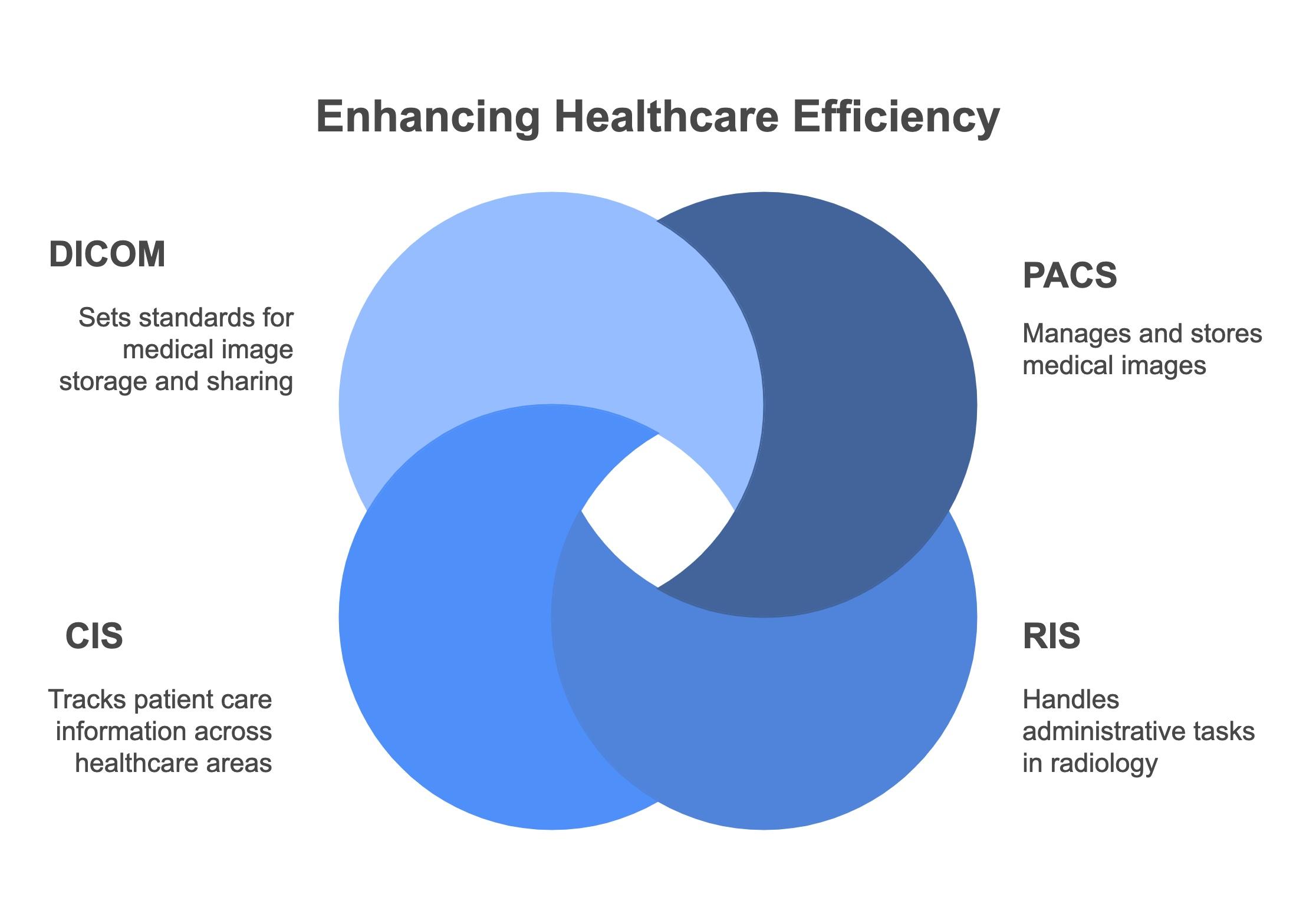
What They Do:
- PACS (Picture Archiving and Communication Systems)**: Manages and stores medical images like X-rays and MRIs.
- RIS (Radiology Information System)**: Handles the admin side of radiology—scheduling, tracking, and billing.
- CIS (Clinical Information System)**: Keeps track of all patient care information across different healthcare areas, aiding in clinical decisions. It includes systems like Electronic Medical Records (EMR) and Electronic Health Records (EHR), which hold comprehensive patient histories and treatment details.
- DICOM (Digital Imaging and Communications in Medicine)**: Sets the standards for how medical images are stored and shared, ensuring devices can talk to each other.
Where They’re Used:
- PACS and DICOM are mostly found in radiology, dealing with images.
- RIS streamlines radiology department operations.
- CIS spans multiple departments, integrating a wide range of patient data, including EMRs and EHRs.
How They Connect:
- PACS and DICOM: Close buddies in managing and exchanging image data.
- RIS and PACS: Often linked to merge imaging data with radiology management.
- CIS: Acts as a hub, connecting with both PACS and RIS to unify patient info, ensuring that EMR and EHR systems are integrated smoothly.
Key Points:
- While PACS and DICOM focus on images, RIS is all about radiology workflows, and CIS covers extensive patient data, including EMR and EHR.
- They all aim to make healthcare smoother and more integrated, each from its own angle but often overlapping in helpful ways.
- This breakdown shows how each system has its specialty, yet they all contribute to a more streamlined and efficient healthcare environment, with CIS central in integrating patient data systems like EMR and EHR.
| Feature | PACS (Picture Archiving and Communication System) | DICOM (Digital Imaging and Communications in Medicine) | RIS (Radiology Information System) | CIS (Clinical Information System) |
|---|---|---|---|---|
| Primary Focus | Storage, retrieval, and distribution of medical images | Standard for handling, storing, printing, and transmitting medical imaging information | Administrative and patient workflow management in radiology | Management of clinical data and support for clinical activities |
| Main Functions | Image storage, image retrieval, image distribution, viewing | Facilitates interoperability of medical imaging devices and systems | Patient registration, scheduling, order tracking, reporting | Collection, storage, and presentation of patient data; clinical documentation |
| Data Managed | Medical images (X-rays, MRIs, CT scans) | Medical imaging information in a standard format | Patient information, scheduling details, radiology reports | Comprehensive patient records, clinical notes, test results |
| Integration | Interfaces with various imaging modalities and RIS | Used by PACS, RIS, and other imaging systems for compatibility | Often integrates with PACS and EHR systems | Can integrate with EHR, RIS, and other healthcare information systems |
| Efficiency Contribution | Improves diagnostic accuracy and decision-making | Ensures seamless communication and data exchange between imaging systems | Enhances administrative efficiency and accuracy | Streamlines clinical workflows and improves patient care coordination |
| Accessibility | Provides remote access to imaging studies | Ensures data is accessible and usable across different platforms | Centralizes patient data for healthcare providers | Offers comprehensive access to patient clinical information |
| Impact on Patient Care | Enhances image management and sharing for better diagnosis | Facilitates accurate and efficient imaging data management | Supports better patient management and streamlined operations | Improves clinical decision-making and patient outcomes |
Technological Synergies
These systems—PACS, RIS, CIS, and DICOM—really shine when they work together, creating a powerhouse for managing medical imaging and data. By integrating these technologies, healthcare IT becomes more streamlined, which means everything from scheduling to patient diagnosis moves faster and more smoothly. This synergy not only boosts the efficiency of hospital workflows (like MRI Interpretation) but also enhances the quality of patient care. With all these systems talking to each other, patient histories are easily accessible, imaging is quick and accurate, and the entire healthcare team can stay well-informed, leading to better, faster decision-making and ultimately, improved patient outcomes.
Every System Plays Its Part
Understanding systems like PACS, RIS, CIS, and DICOM is essential for healthcare providers aiming to streamline their PACS clinical system operations and enhance patient care. These technologies manage medical imaging and patient data efficiently. Looking ahead, we can expect even tighter integration and smarter analytics within these systems, improving diagnostics and efficiency. Staying on top of how these systems interact is key—not just for handling today’s needs but also for gearing up for future advancements in healthcare technology.
