
Have you ever found yourself juggling multiple systems when trying to share patient data or access critical diagnostic images? You’re not alone. Many healthcare professionals grapple with siloed systems that cause inefficient workflows and can hinder patient care. This frustration often stems from using a PACS (known as PACS) that doesn’t play nicely with other platforms—ultimately creating barriers to streamlined communication between different systems. The good news is that there’s a clear path forward: by focusing on collaboration between various PACS and health systems, healthcare providers and patients both benefit from faster turnaround times, better patient outcomes and enhanced patient care.
In this blog post, we’ll explore how these picture archiving and communication system technologies have evolved to support interoperability, and we’ll pinpoint the key steps to integrate PACS effectively across the healthcare industry. We’ll also take a close look at Radsource’s ProtonPACS as a powerful model for bridging gaps and unifying multiple systems. Ready to save time and simplify your medical image retrieval processes? Let’s dive in.
Key Takeaways
- Seamless Integration Matters: Integrating RIS and PACS can eliminate siloed systems and cut down on duplicate tasks—ultimately improving patient care while reducing costs.
- Standards and Collaboration: DICOM, HL7, and a robust hospital information system are key components that enable communication between different systems, making it simpler to share medical images across facilities.
- Future-Proof with the Cloud: A cloud-based PACS offers the scalability, security, and real-time accessibility that modern healthcare needs, ensuring that healthcare professionals to access critical data from anywhere.
Introduction
A PACS (short for “PACS includes” any system that manages digital images like X-ray scans) is more than just another piece of hospital technology; it’s the evolution of PACS that has revolutionized how medical imaging and patient care moves swiftly within radiology. A modern PACS can store and organize medical imaging information, so radiologists and other healthcare professionals can access essential diagnostic images quickly. These archiving systems are central to the healthcare ecosystem, enabling everything from image acquisition to advanced analysis.
Today’s healthcare systems can involve many PACS solutions and various systems—often from different vendors. The development of PACS was intended to unify and streamline the workflow in a radiology department, but when multiple PACS servers or hospital information system platforms don’t talk to each other, it creates data silos. Patients can suffer from delayed care, and radiologists face cumbersome processes. Collaboration and integrating RIS and PACS across these separate systems are crucial to improving overall workflow efficiency, accelerating turnaround times, and enhancing patient care.
Radsource, through its ProtonPACS, provides a unified system that integrates with RIS and other electronic health platforms, ensuring that stored PACS images can be easily shared among diverse facilities. This approach to integrated systems addresses the common communication gaps that many PACS face, positioning ProtonPACS as a robust solution that meets the demands of modern healthcare providers. By prioritizing ease of use, compliance with standards like DICOM (Digital Imaging and Communications in Medicine), and a vendor-neutral architecture, Radsource’s ProtonPACS ensures that healthcare information is consistently accessible across different imaging modalities and multiple systems.
Collaboration between PACS solutions isn’t just about technology; it’s about patient outcomes. By establishing smooth communication between different systems—such as a radiology information system, an electronic health record, and a hospital information system—organizations can save time, reduce manual tasks, and enhance diagnostic accuracy. This blog will delve deeper into how ProtonPACS and other modern PACS platforms make these improvements possible.
The Challenge of Isolated PACS in Healthcare
In many medical systems, older or existing PACS solutions operate in isolation, making it difficult to access medical images across departments or share patient information seamlessly. These siloed systems arise when a picture archiving and communication system isn’t built with interoperability at its core, forcing staff to navigate multiple logins and re-enter data into separate systems.
Issues caused by non-integrated RIS and PACS
- Delayed retrieval of patient data. Without a direct link between a radiology system and a PACS server, retrieving information and medical images can become labor-intensive.
- Inefficient radiology workflows. Radiologists often switch between different interfaces, increasing the risk of errors and wasting valuable time.
- Increased costs due to duplicate systems. Maintaining many PACS frameworks or separate imaging systems is expensive and can impede healthcare providers’ ability to offer cost-effective patient care.
Standards like the DICOM standard (short for Digital Imaging and Communications) and HL7 (Health Level Seven) exist to ensure that data moves freely between systems with PACS. DICOM images maintain consistent formatting for medical imaging technology, while HL7 structures messaging between electronic health records and other hospital information. Without these standards, it would be nearly impossible to share medical images or connect different types of medical data.
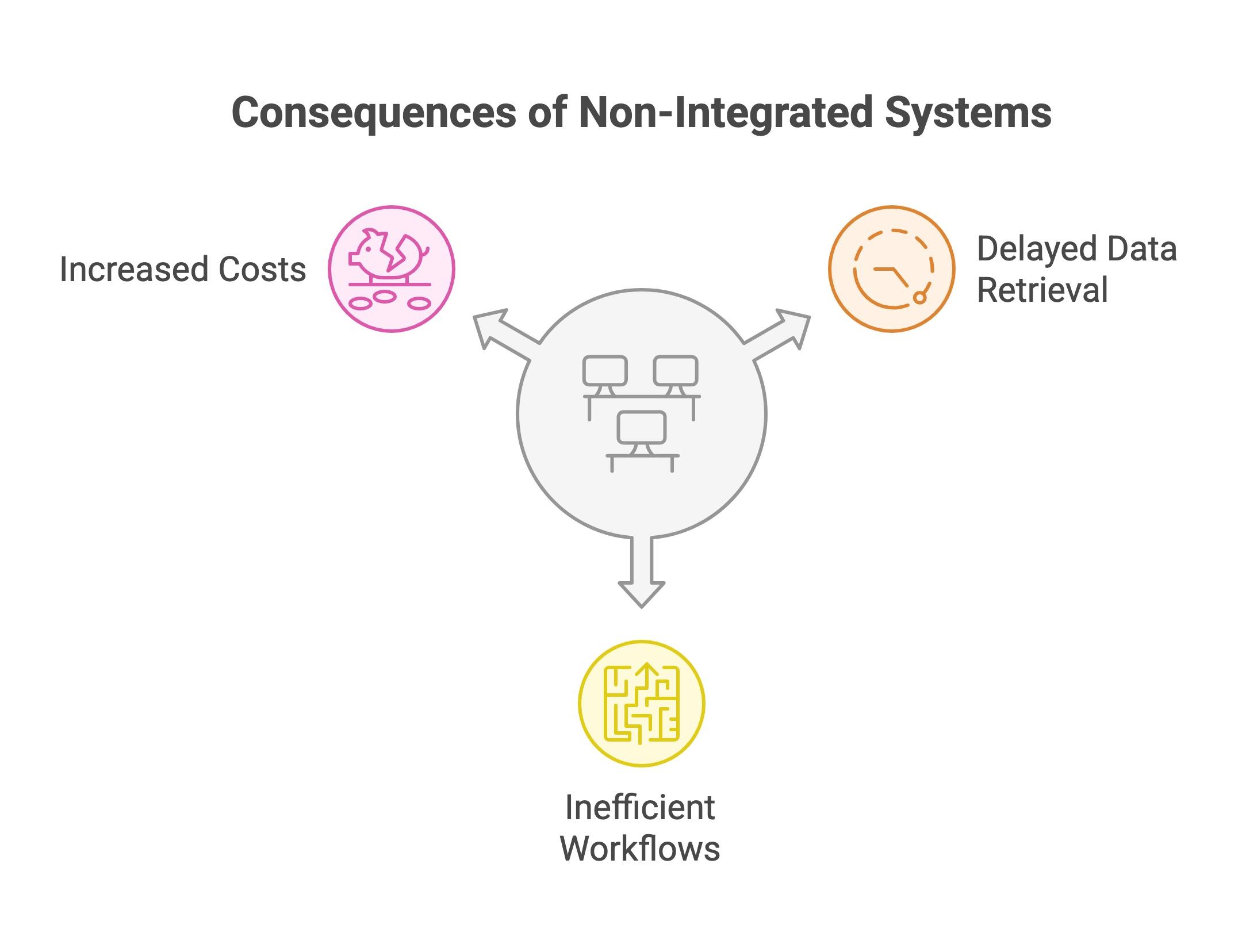
Issues caused by non-integrated RIS and PACS
How PACS Collaboration Improves Healthcare Systems
Healthcare organizations are increasingly aware that integrating RIS and PACS is vital for a more unified, efficient process. A system that manages all medical imaging information alongside patient care logistics can reduce administrative burdens, cut down on redundant tasks, and directly improve the impact of PACS on departmental performance. Integrate PACS effectively, and you’ll see how it streamlines the workflow, from ordering imaging studies to final diagnostic reporting.
Benefits of connected PACS solutions
- Faster medical image access and retrieval. When multiple imaging systems communicate smoothly, radiologists can quickly pull up images from any modality—MRI, CT, or X-ray.
- Enhanced diagnostic accuracy through multi-PACS data sharing. Radiologists can compare digital images from different facilities or networks, leading to more comprehensive diagnoses.
- Reduction in redundant imaging and unnecessary patient radiation exposure. By using a PACS that fosters data-sharing, healthcare professionals minimize repeated tests, thereby lowering costs and improving patient safety.
ProtonPACS was developed by Radsource to address real-world collaboration challenges. It adheres to robust DICOM standard protocols, integrates smoothly with a radiology information system or a hospital information system, and fosters direct communication with electronic health record solutions. The result? A platform that helps radiologists, within radiology departments, consolidate diagnostic data and optimize workflow in ways that older or less flexible solutions simply cannot.
The Role of DICOM and HL7 in PACS Interoperability
Digital imaging and communications in medicine, or DICOM, provides a universal language for medical imaging and patient care. From MRI scans to digital images of ultrasound, DICOM images allow various systems—whether they’re from the same vendor or not—to share consistent data. This uniformity is essential for a healthcare industry that increasingly relies on cross-vendor collaboration.
HL7 (health level standards) focuses on structuring data and messages among different systems, including a hospital information system (HIS), an RIS, and a PACS system. By using a PACS that supports HL7, facilities ensure patient information flows seamlessly among caregivers, administrators, and radiologists. This integration helps reduce errors and fosters better patient outcomes.
Not all PACS uses the DICOM standard in the same way. Some vendors implement proprietary extensions or limit certain functionalities, causing data-sharing hiccups. This can hamper the communication between different types of medical software and hamper efforts to unify data in a single system.
ProtonPACS goes beyond minimal compliance: it’s built to ensure that data from any imaging modality is easily interpreted, stored, and transmitted. By prioritizing robust DICOM image support and HL7 messaging, Radsource’s platform fosters an environment where multiple systems can effortlessly exchange health information.
Cloud-Based PACS: The Future of Interconnected Imaging Systems
As systems continue to grow in scope and complexity, the healthcare industry is moving away from on-premise PACS setups. A cloud-based PACS significantly reduces overhead costs, eliminates hardware constraints, and makes it easier for healthcare providers to scale. By hosting a PACS archive in the cloud, organizations can quickly upgrade storage capacity or computing resources as patient volumes grow, thereby supporting better patient care.
Advantages of cloud PACS in multi-facility health networks
- Real-time access to medical images across departments. Cloud PACS lets clinicians and radiologists quickly access medical images from any location, enabling faster diagnostic decisions.
- Cost-effective retrieval and storage solutions. Because data is stored remotely, facilities don’t need to invest heavily in local servers or maintenance, which helps them save time and resources.
- Scalable infrastructure for growing radiology practices. Whether you’re part of a large hospital network or a smaller clinic, cloud solutions flex with your needs, making them ideal for dynamic healthcare environments.

Advantages of cloud PACS in multi-facility health networks
ProtonPACS offers a “best of both worlds” model: a robust on-site infrastructure that pairs seamlessly with cloud resources for flexible archiving systems and quick retrieval. This hybrid approach ensures that healthcare providers and patients receive uninterrupted services even if the internet connection is disrupted. At the same time, the cloud-based capabilities make it possible to share medical images across locations without missing a beat.
The Importance of Workflow Optimization in PACS-RIS Integration
Integrating RIS and PACS is crucial to unifying patient scheduling, reporting, and imaging data into one cohesive process. When a single system handles everything from image acquisition to final reporting, radiologists can focus on diagnostic interpretation without toggling between different user interfaces. This synergy also supports improved accountability and ensures data accuracy throughout the radiology department.
ProtonPACS minimizes workflow inefficiencies with:
- Automated image retrieval and routing: By automatically sending digital images to the correct specialist or department, ProtonPACS reduces manual input and speeds up turnarounds.
- Intuitive user interface for radiologists and referring physicians: An easy-to-navigate PACS offers fewer learning curves and less chance of data-entry errors.
- Smart reporting tools for streamlined workflow management: Built-in analytics and automated reporting features mean everyone in the radiology system gets the data they need at the right time, reducing rework and helping patient information flow more smoothly.
Security & Compliance in PACS Collaboration
As more data is shared via PACS, safeguarding protected health information becomes paramount. Healthcare organizations must ensure their systems require robust encryption, user authentication, and continuous monitoring. This is especially true when dealing with cloud or hybrid infrastructures, where data can traverse multiple networks.
When separate systems exchange data, each system must meet rigorous compliance standards. Any vulnerability in one platform can expose an entire network to cyber threats. Ensuring that data remains encrypted, whether in transit or at rest, helps protect sensitive patient information.
ProtonPACS uses advanced encryption protocols and role-based access controls to ensure that only authorized personnel can access digital images. These built-in security measures align with HIPAA regulations, meaning healthcare providers can trust the platform without worrying about undue bureaucracy or slowed performance.
Conclusion: Why Radsource’s ProtonPACS is the Ideal Collaborative PACS Solution
In an era where medical imaging and patient care are increasingly complex, the ability to communicate seamlessly across different systems is paramount. PACS eliminates the need for inefficient, siloed data management, paving the way for more accurate diagnoses and enhanced collaboration.
ProtonPACS vs. other solutions:
- The vendor-neutral design ensures seamless integration: By adopting open standards, ProtonPACS effectively bridges separate systems, facilitating smooth communication between different systems and enabling a truly unified workflow.
- Hybrid cloud-PACS model for flexibility: ProtonPACS strikes the perfect balance between on-site performance and remote scalability, making it ideal for modern healthcare facilities looking to expand.
- Optimized workflow for radiologists, hospitals, and specialty clinics: The system that manages everything from initial image acquisition to final reporting ensures that each step in the chain is as efficient and accurate as possible.
When it comes to the impact of PACS on patient outcomes and operational efficiency, investing in a robust solution like ProtonPACS can make all the difference. By prioritizing interoperability, security, and advanced features, Radsource is setting a new standard in how we approach medical imaging technology. For healthcare providers seeking to adapt to an ever-evolving landscape, ProtonPACS offers a proven way to bolster collaboration, ensure secure data exchange, and deliver better patient outcomes across every stage of the care journey.
Ready to experience the power of a modern PACS that streamlines the workflow across multiple facilities? Contact Radsource today to learn how ProtonPACS can be tailored to your organization’s needs—helping you integrate PACS seamlessly, improve diagnostic accuracy, and foster a collaborative environment that benefits both healthcare professionals and the patients they serve. Together, let’s embrace the future of medical imaging, one securely connected system at a time.
