
Imagine walking into your radiology department each morning, hoping that your imaging software will not only make life easier for your team but also justify the significant cost you’ve invested. Yet, day after day, you find yourself wrestling with slow load times, unexpected fees, and clunky interfaces.
If this scenario sounds familiar, you might be overpaying for a PACS (Picture Archiving and Communication System) that isn’t delivering the performance you deserve. In a world where budgets are tight and patient care standards are higher than ever, it’s essential to ensure you’re getting real value—and real results—from your PACS solution.
The Real Cost of a PACS That Doesn’t Perform
Budgets in healthcare are notoriously tight. Every dollar must prove its worth, especially for technology like PACS which should drive both clinical efficiency and financial return on investment (ROI). Unfortunately, many healthcare providers find themselves locked into expensive, bloated systems that promise the world but underdeliver on speed, stability, and service. This isn’t just a mild inconvenience—it can be a major drain on your operational budget and compromise patient care in the long run.
At Radsource, we believe imaging software should actively support your workflows, drive ROI, and enhance patient outcomes, not silently erode your budget. It’s not about cutting corners; it’s about ensuring that every feature, every integration, and every contract term genuinely supports your team’s needs. An underperforming PACS doesn’t just cost you money—it costs time, referrer satisfaction, and ultimately, patient trust.
The Hidden Costs of an Underperforming PACS
When a PACS fails to meet your needs, the financial impact isn’t always obvious on the surface. Downtime, slow system response, and unwieldy licensing fees can all accumulate into a bigger expense than you might suspect. Let’s explore the hidden costs that often lurk beneath the line item labeled “PACS Contract.”
Delayed Radiology Reports = Lost Referrals and Revenue
If your radiologists can’t generate timely, accurate reports, your referring physicians will notice. Extended turnaround times or delayed diagnoses can push those referrals elsewhere, directly affecting your bottom line. When word spreads that images and reports take too long to come back, you risk losing the trust of both practitioners and patients.
Downtime Interrupts Imaging Workflows and Impacts Patient Care
Every minute your PACS is down translates into clinical delays: patients waiting longer for scans, radiologists postponing interpretations, and staff juggling workarounds. Over time, these small disruptions add up. Frequent downtime can set off a chain reaction of inefficiencies, extending wait times, adding stress for staff, and undermining patient confidence.
Licensing, Storage, and Service Fees That Don’t Scale With Your Needs
One of the most overlooked aspects of an underperforming PACS is how inflexible it can be as your organization evolves. You might find yourself locked into licensing agreements that charge you for “features” you never use or for storage solutions that aren’t optimized for your volume. When your practice grows, you don’t want scaling up to result in exorbitant new costs—yet that’s often the case with legacy PACS contracts.
IT Time Spent Fixing vs. Improving Systems
A strong PACS should free up your IT team to focus on big-picture improvements rather than constant troubleshooting. Underperforming systems eat away at IT resources; instead of innovating or fine-tuning processes, they’re stuck putting out fires. This hidden labor cost can be substantial, reducing your ability to innovate and adapt quickly in a competitive healthcare landscape.
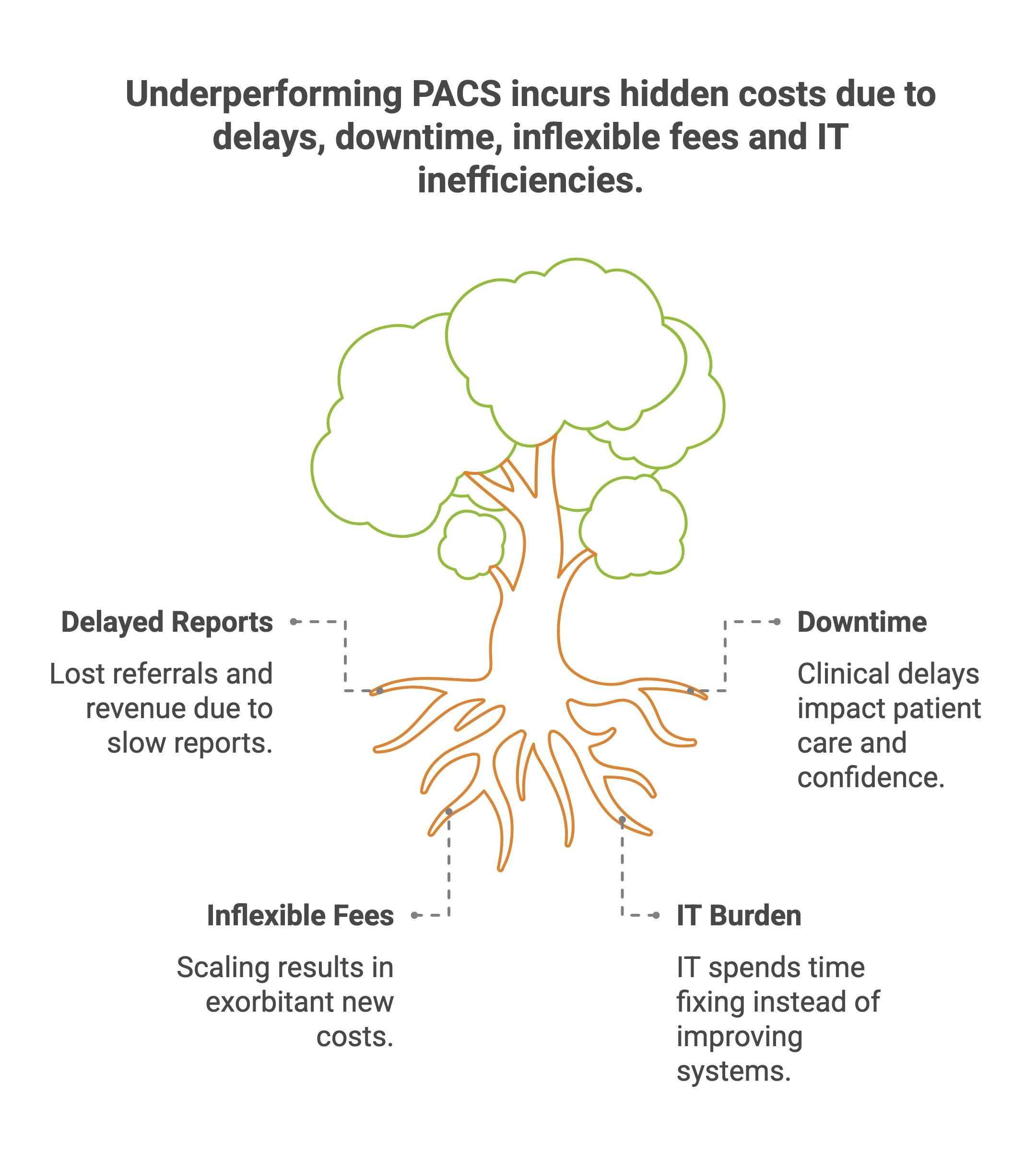
The Hidden Costs of an Underperforming PACS
How to Know If You’re Paying Too Much for Too Little
You might suspect you’re overpaying, but how can you know for sure? Below are common red flags that can help you identify whether your PACS is underperforming and eating away at your budget.
You’re Paying for Features You Never Use
“Comprehensive” feature lists can be deceptive. Ask yourself which tools your team uses daily and which sit idle. If you find that your monthly or annual PACS fees are padded with seldom-used bells and whistles, it’s likely time to reassess whether the system aligns with your clinical and financial goals.
System Performance Doesn’t Match Vendor Promises
Sales presentations and vendor demos often showcase a best-case scenario. However, if your everyday reality involves sluggish image rendering or software freezes, you’re probably not getting what you paid for. Constant performance issues can drain your budget and fray user trust, making it harder to adopt new features or expand services.
Upgrades Require More Spend, Not Less
Upgrading a PACS should ideally offer more efficiency at the same or a lower cost. Yet some vendors charge premium fees for necessary enhancements, turning what should be a natural system improvement into an added financial burden. If you can’t evolve without incurring steep new charges, your PACS may be doing more harm than good.
Your Radiology Team Works Around the PACS—Not With It
Your radiologists are skilled professionals, but if they spend more time figuring out workarounds for your PACS than actually interpreting images, it’s a clear sign of inefficiency. Tools should complement clinical expertise, not obstruct it. A telltale sign of an underperforming system is when the PACS becomes an obstacle instead of a partner in care.
What a High-Value PACS Should Actually Deliver
Not all PACS solutions are created equal. A high-value PACS prioritizes both the user experience and cost-effectiveness, ensuring that healthcare providers see real returns in productivity, collaboration, and patient outcomes. Here’s what you should look for.
Transparent, Predictable Pricing—No Surprises
Gone are the days when healthcare providers should accept hidden fees or vague pricing tiers. A transparent cost structure lets you plan and budget effectively, reducing the stress on your financial department and allowing you to invest in other crucial areas of patient care.
Fast Access to Medical Images, Even Across Modalities
Speed and compatibility are paramount in modern radiology. Whether you’re accessing MRI, CT, or ultrasound images, a high-value PACS ensures rapid rendering and a smooth interface. Quick load times and clear imaging empower radiologists to make faster, more accurate diagnoses.
Built-In Scalability for RIS and PACS Expansion
Healthcare institutions evolve over time, and so do their technological needs. An ideal PACS can scale alongside your facility without requiring expensive overhauls. Whether you’re integrating with a new Radiology Information System (RIS) or adding another imaging center, scalability should be a built-in feature, not a premium add-on.
Reliable Uptime That Supports Imaging Throughput
A top-tier PACS minimizes unexpected downtime and ensures consistent performance. This reliability is non-negotiable when patient care is on the line. You should be able to trust your system to function optimally, even during peak usage periods or network fluctuations.
The ProtonPACS Difference—Designed to Outperform, Priced to Fit
Choosing a PACS provider is about more than just technology; it’s about partnering with a company that understands both clinical demands and financial realities. ProtonPACS by Radsource is engineered to align with your practice’s evolving needs, all while offering predictable, cost-effective pricing.
Pay-Per-Study Model = No Bloated Contracts
A pay-per-study model can dramatically reduce upfront expenditures. Instead of committing to an all-inclusive contract that bundles in features and storage you don’t need, you pay only for the volume you actually use. This streamlined approach can free up your budget for other crucial areas of patient care.
Cloud-Hybrid Architecture = Uptime and Flexibility
ProtonPACS leverages a secure cloud-hybrid model, giving you both reliability and the ability to adapt to shifting clinical demands. Whether you need on-site caching for quick image access or cloud storage for scalable archiving, the system is built to keep you running smoothly.
Seamless PACS and RIS Integration = Smoother Workflow
Radsource understands that cohesive workflows are at the heart of efficient care. ProtonPACS integrates effortlessly with leading Radiology Information Systems, reducing data silos and duplication. This synergy translates to quicker report turnaround and more satisfied clinicians and patients.
Tailored for Your Specialty = No One-Size-Fits-All Bloat
ProtonPACS is built with specialties like radiology, orthopedics, OB/GYN, and more in mind. By tailoring the system to match your exact needs, you avoid the pitfalls of one-size-fits-all models that often come loaded with features you’ll never use. Focusing on relevant tools enhances user adoption and streamlines clinical operations.
Why “Just Getting By” with PACS Is a Risk You Can’t Afford
In healthcare, complacency can carry severe consequences. Relying on a PACS that barely meets minimal requirements can translate into long-term costs—both financial and clinical. Below are key reasons why settling for an underperforming system is not an option.
Operational Inefficiencies Accumulate in Silence
It’s easy to ignore minor slowdowns or occasional system glitches, but these inefficiencies add up. Over a year, small frustrations become big drains on staff productivity and patient satisfaction, eroding any financial gains you hoped to achieve.
Staff Burnout from Slow, Clunky Systems
Healthcare professionals already face tremendous stress. A sluggish PACS only amplifies that stress, leading to lower morale and, ultimately, higher turnover. Engaged, efficient staff is essential for quality patient care, so any technology causing burnout has a hidden—and very real—cost.
Delayed Imaging = Delayed Diagnosis = Patient Impact
When imaging workflows are slow or unreliable, patients feel the effects. Delayed diagnoses can impact treatment plans and, in some cases, patient outcomes. Over time, a reputation for slow service can deter patients from seeking care at your facility, further hurting revenue and community trust.
Leadership Needs Data-Driven Tech Decision
Hospital and radiology leaders rely on data to guide critical investments. If your current PACS is short on actionable metrics or fails to show tangible ROI, it’s hard to justify ongoing expenses. Transitioning to a data-friendly, performance-focused PACS can be a game changer for operational strategy.
Conclusion: You Deserve a PACS That Works as Hard as You Do
At the end of the day, it’s not about spending more—it’s about spending smarter. Radiology leaders shouldn’t settle for underperforming, overpriced systems that fail to deliver real clinical and financial returns. You deserve technology that actively supports your team, streamlines patient care, and adapts to your evolving needs.
If you’ve recognized any of these red flags in your current setup, take the next step and explore how ProtonPACS by Radsource can offer a lean, high-performance alternative. A PACS that truly works as hard as you do is within reach—let’s connect and find a solution that fits your budget and exceeds your expectations.
