
Healthcare providers and patients alike often encounter frustrating delays or inaccurate results when orthopaedic images are blurry, distorted, or lacking in detaiorthopedicsues become critical challenges for anyone needing a clear path toward relief from pain or mobility issues.
Imagine being in discomfort—perhaps from a suspected fracture or a persistent joint ache—only to learn that you must retake scans multiple times because initial medical images weren’t sharp enough. This leads to more time off work, increased costs, and a profound sense of uncertainty about your treatment plan and patient outcomes. It’s not just about convenience—it’s about accurate diagnoses and ensuring a swift path to effective treatment.
In this blog post, you’ll discover why image clarity is the foundation of orthopedic diagnostics, how poor-quality imaging can delay or derail care, and how advanced solutions such as ProtonPACS from Radsource significantly improve the process—from image acquisition to final reporting. Our goal is to empower you with knowledge so you can make informed decisions and receive the best possible care you deserve.
Key Takeaways
- High-quality imaging ensures better orthopedic diagnostics: Clarity directly affects diagnostic accuracy, reducing the need for retakes and minimizing the risk of complications.
- Modern imaging systems: Digital X-ray systems provide high-resolution images and 3D imaging tX-rays to improve patient confidence and support accurate diagnosis and surgical planning.
- Partnering with experts and technology: Orthopedic specialists and advanced platforms like ProtonPACS significantly improve workflow, reducing inefficiencies and improving patient care.
How Poor Image Quality Impacts Orthopedic Patient Care
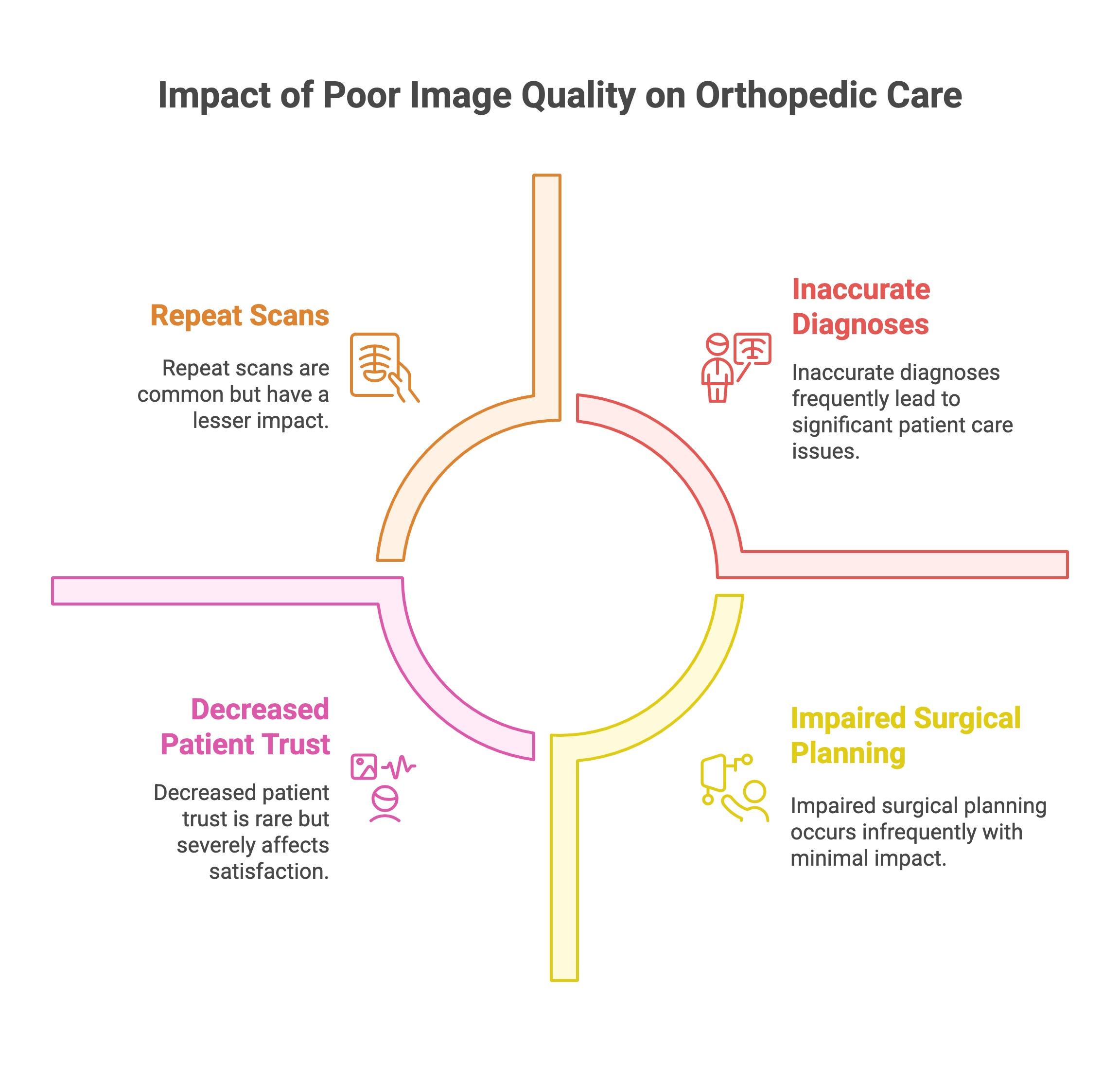
Inaccurate Diagnoses and Missed Findings
Poor-quality scans undermine a provider’s ability to detect a subtle fracture or minor lesion. A blurry, simple x-ray might miss micro-tears or faint lines in a bone and joint region, jeopardizing accurate diagnoses.
From hairline fractures to partial ligament tears, many orthopedic conditions require crystal-clear imaging. A fuzzy scan can lead to misinterpretation, delayed effective treatment, or increased risk of complications.
ProtonPACS uses best practices in image acquisition to provide high-resolution images, along with real-time viewing options for an orthopedic surgeon or physician. This synergy streamlines reads and helps ensure diagnostic reliability.
Repeat Scans and Workflow Bottlenecks
When imaging lacks detail, retakes become inevitable. This burden extends from scheduling to radiology departments and surgeons waiting for final reads. Multiple imaging methods may be ordered unnecessarily, causing longer wait times and frustration.
Beyond inefficiencies, repeating a ct scan or multiple x-ray shots adds to radiation exposure. It also demands more staff resources, driving up operational costs and slowing overall orthopedic care.
Impaired Surgical Planning and Outcomes
Surgical teams rely on accurate imaging to map the exact hardware placement or repair needed. Blurry images raise the risk of complications and can extend recovery time or lead to additional procedures.
Decreased Patient Trust and Satisfaction
In a time when patients expect rapid results, retakes or unclear findings quickly erode trust. Individuals dealing with orthopedic medicine often face anxiety about mobility and pain; prolonged delays exacerbate these concerns.
Clinics that consistently produce subpar imaging or require repeated scans lose the confidence of both referring orthopedic doctors and patients. This can harm long-term reputation and viability.
Impact of Poor Image Quality on Orthopaedic Care
Imaging Modalities That Shape Orthopaedic Diagnostics
Digital X-Ray in Orthopedics
X-rays are often the first line of defense in diagnosing orthopedic conditions. Modern digital x-ray systems provide high-resolution images, revealing subtle fractures or issues with alignment and arthritis.
Older x-ray equipment yields grainy images, making it difficult to identify micro-cracks or joint space narrowing. That’s why x-ray systems provide high-resolution images as a significant step forward in ensuring accurate diagnoses.
MRI and Soft Tissue Evaluation
An MRI is indispensable for viewing soft tissue damage. Whether assessing cartilage wear or a tendon tear, the level of detail allows clinicians to develop personalized treatment plans.
MRI supports accurate diagnosis and surgical planning for chronic conditions, such as complex lesions or nerve entrapments. This level of detail often goes beyond what simpler scans can reveal.
CT Scans and 3D Orthopedic Imaging
A ct scan often assembles images from different angles into 3D imaging. This is crucial for accurate mapping of complex fractures and guiding surgical intervention.
Ultrasound for Dynamic Joint Analysis
Ultrasound offers real-time x-ray imaging of movement—especially helpful for diagnosing tendon subluxations and joint effusions. It assists orthopedic specialists in evaluating live joint function and reducing critical challenges in orthopedic diagnoses.
Optimizing Imaging Clarity Through Technology & Expertise
Invest in High-Resolution Equipment
High-end tools provide orthopedic professionals the clarity to detect a bone tumor or a subtle crack that could hinder orthopedic surgery. Such advanced imaging technologies do more than produce clear pictures; they significantly improve patient outcomes.
Accurate imaging depends on both leading-edge machinery and robust software. ProtonPACS unifies imaging data with streamlined workflows so each radiologist can leverage machine learning to interpret scans swiftly and precisely.
Implement Cloud-Hybrid PACS for Seamless Image Management
ProtonPACS uses a secure, cloud-hybrid environment for image processing and sharing. This real-time capacity reduces repeated steps that slow orthopedic care.
Automated data synchronization with Electronic Health Records and Radiology Information Systems enhances the efficiency of routine tasks, focusing efforts on timely diagnoses instead of administrative hurdles.
Standardize Imaging Protocols for Consistent Results
Differences in exposure settings or outdated equipment can degrade clarity. Setting consistent standards ensures uniform outcomes and decreases the need for retakes.
Partner with Subspecialized Musculoskeletal Radiologists
Choosing the right orthopedic imaging often requires radiologists who specialize in musculoskeletal anatomy. They understand the nuances of x-ray technology, MRI, and CT, helping orthopedic doctors develop effective treatment plans.
A specialized reading team quickly identifies anomalies, keeping the process on track for surgical intervention or rehabilitation. Swift, precise interpretation is fundamental to improving patient care and satisfaction.
Choosing the Right Orthopedic Imaging System
What to Look for in Orthopaedic PACS Solutions
- Confirm the system delivers enhanced image quality across varied imaging modalities. High-fidelity clarity is non-negotiable.
- Seamless data exchange cuts administrative burdens and ensures no critical details are overlooked.
- A platform that grants immediate, protected access fosters timely decisions and early detection of potential problems.
How Radsource’s ProtonPACS Stands Out
ProtonPACS is structured to handle large volumes of diagnostics while accommodating the specific needs of orthopedic specialists.
Instead of a hefty initial investment, clinics pay per study. This approach can be particularly beneficial for smaller or budget-focused facilities.
ProtonPACS scales to different healthcare environments, offering real-time access and cloud archiving that keeps medical images safe and readily available.
Conclusion: Image Clarity Isn’t Optional—It’s Foundational to Orthopaedic Care
Imaging plays a pivotal role in ensuring crucial for accurate diagnostic decisions. Whether your orthopedic surgeon is planning a hip and knee replacement or seeking to find a hairline fracture, top-tier scans ensure there are no blind spots. High-resolution imaging fosters trust, prevents retakes and gives surgeons the detail they need for surgical planning.
By integrating artificial intelligence and the latest machine learning approaches, Radsource’s ProtonPACS leads the way in orthopedic medicine, reducing redundancy and maximizing efficiency for the best possible care.
If you’re dealing with repeated scans or outdated hardware, it’s time for an upgrade. Don’t let unclear images hinder a surgeon’s readiness or delay a diagnosis. Choosing the right orthopedic imaging solution is a significant step forward in providing excellent care—whether patients are asked to remove metal objects for an MRI or receiving a real-time ultrasound. Make the move today to ensure delivering the clarity and personalized treatment plans that modern orthopedic doctors demand.
